


A new Global InfoAnalytics poll has put President John Dramani Mahama’s approval rating at 71%, sharply contradicting a recent Institute of Economic Affairs (IEA) survey that placed it at 58.9%.
The June 2026 National Tracking Poll, released on Sunday, June 15, shows the President’s approval rating rising from 67% in March to 71%, with 23% of respondents disapproving and 6% expressing no opinion.
Follow our WhatsApp channel for more interesting and relevant news
Global InfoAnalytics says the 71% figure is the highest approval rating it has recorded for any sitting president in its regular tracking series since 2020.
The findings arrive at a time when debates over jobs, electricity supply, the economy and the cost of living continue to dominate national conversations, making the sharp contrast between the two surveys especially noteworthy.
At a glance
Global InfoAnalytics: 71% approval, 23% disapproval
IEA: 58.9% approval, 28.4% disapproval
Global InfoAnalytics Poll Shows Broad National Support for Mahama
According to the survey, 66% of Ghanaians believe the country is heading in the right direction, while 27% think it is moving in the wrong direction. Those figures have remained largely unchanged from the March tracking poll.
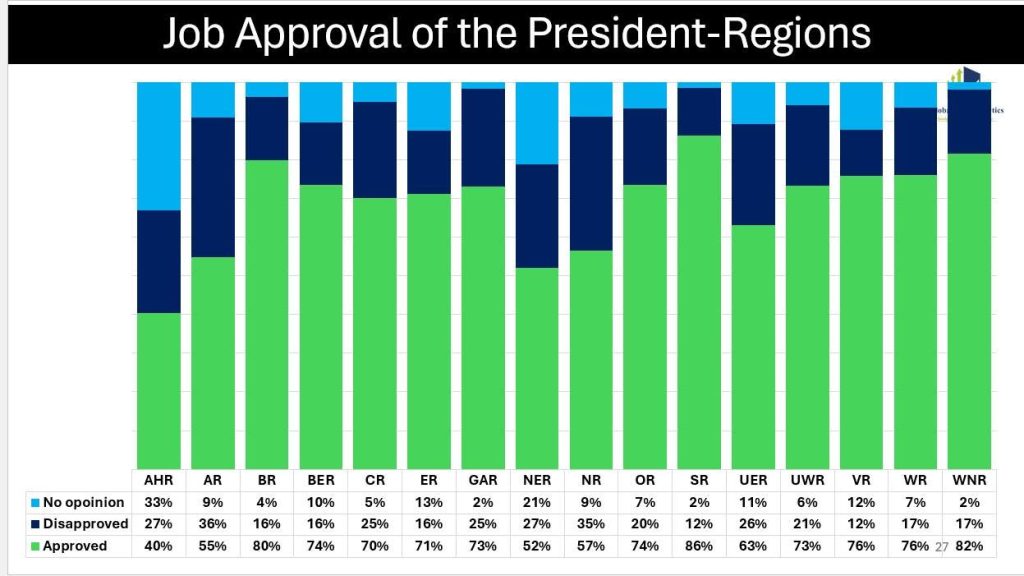
Regional results also point to significant differences across the country.
The Savannah Region recorded the highest approval rating at 86%, followed by Western North at 82%, the Western Region at 76%, Greater Accra at 73%, and the Central Region at 70%.
At the lower end of the scale, Ahafo recorded 40%, North East 52%, and Ashanti Region 55%.
The political divide was equally pronounced.
Among NDC supporters, 91% approve of President Mahama’s performance and only 6% disapprove.
Among NPP sympathisers, 37% approve while 54% disapprove.
Floating voters also gave the President a positive assessment, with a majority expressing approval of his performance.
What Makes the Global InfoAnalytics Poll Different From the IEA Survey?
The contrasting headlines have naturally raised questions about why the two surveys produced different figures.
Global InfoAnalytics conducted its poll between May 30 and June 12, 2026, sampling 8,784 voters across all 16 regions and 84 constituencies. Of these, 7,484 respondents were interviewed face to face while 1,302 participated through online responses. The poll reports a 99% confidence level and a margin of error of ±2.5%.
By comparison, the IEA survey was conducted in May 2026 using more than 1,000 respondents across all 16 regions and found President Mahama’s approval rating at 58.9%, down from 68% in December 2025.
Differences in sample size, fieldwork dates, data collection methods and polling methodology can produce different headline results. Despite the numerical gap, both surveys indicate that a majority of respondents still approve of the President’s performance.
Poll Suggests Improving Living Standards and Greater Optimism
The Global InfoAnalytics survey also paints an optimistic picture of personal living conditions.
Some 57% of respondents said their standard of living has improved compared with a year ago.
Only 16% said it had worsened, while 23% reported no change.
Looking ahead, 68% expect their standard of living to improve over the next 12 months.
The survey also found that 54% believe corruption has improved, while 21% think it has worsened.
When respondents were asked which institution is best placed to fight corruption, 36% said both the Attorney General and the Office of the Special Prosecutor could do so equally.
Among those who chose only one institution, 24% preferred the Attorney General while 16% selected the Office of the Special Prosecutor.

Global InfoAnalytics Poll Highlights Unemployment, Economy and Dumsor Concerns
Despite the President’s strong approval numbers, respondents identified several areas where they believe government performance remains weakest.
Unemployment topped the list at 44%.
The general economy followed at 32%, while dumsor was cited by 29% of respondents.
The survey also explored broader social issues.
A majority of 67% supported publishing photographs of adults caught engaging in examination malpractice as a deterrent, while only 13% opposed the proposal.
On school discipline, 38% favoured the reintroduction of corporal punishment, 27% supported suspension and 20% preferred community service.
Global InfoAnalytics Poll Finds Majority Want Younger Political Leadership
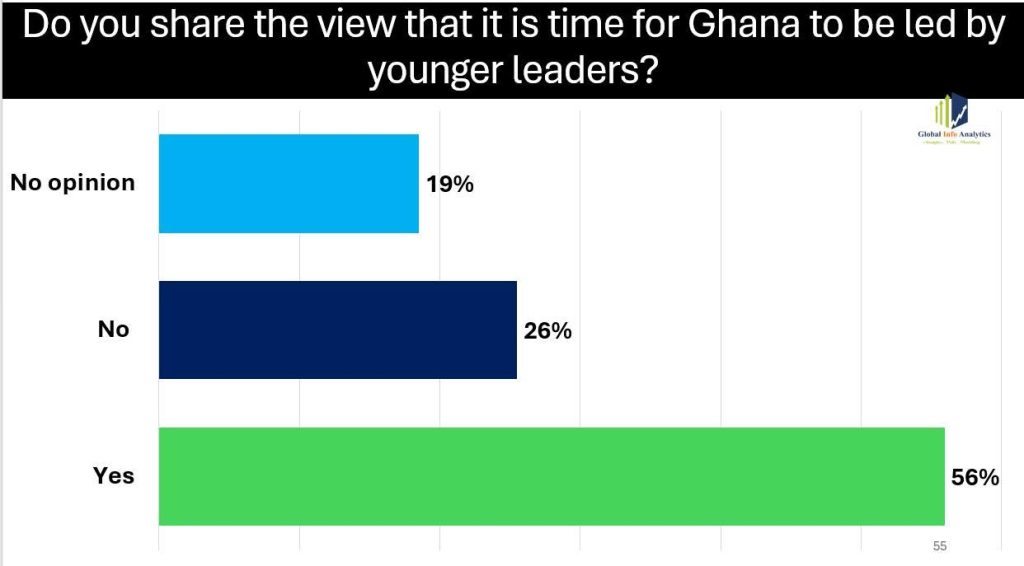
The poll also reveals growing interest in generational change.
Overall, 57% of respondents said they would prefer Ghana to be led by younger people in the future, while 26% disagreed.
Support was strongest in the Savannah Region at 89% and Upper West at 82%.
However, majorities in the Ashanti, Bono and Western North regions did not share that preference.
When asked what age they would consider too old to lead the country, 21% said age is irrelevant.
Another 17% placed the threshold between 50 and 54 years, while 46% said 65 years and above.

IEA Poll Points to Rising Expectations Despite Continued Majority Approval
The IEA survey presents a different picture of the President’s standing, reporting an approval rating of 58.9%, down from 68% in December 2025.
Despite the decline, approval still substantially exceeds the 28.4% who disapprove.
According to the institute, the economy remains the strongest driver of support, with respondents pointing to easing inflation, cedi appreciation, lower interest rates and improvements in Ghana’s sovereign credit ratings.
However, concerns over electricity supply, cost of living pressures and corruption continue to influence public perceptions.
The IEA concluded that while Ghanaians remain broadly supportive of President Mahama’s leadership, expectations are rising for more visible improvements in jobs, incomes and everyday living conditions.
Poll Methodology
Global InfoAnalytics
- Fieldwork: May 30 to June 12, 2026
- Sample size: 8,784 voters
- Coverage: All 16 regions and 84 constituencies
- Face-to-face interviews: 7,484
- Online respondents: 1,302
- Confidence level: 99%
- Margin of error: ±2.5%
Institute of Economic Affairs (IEA)
- Fieldwork: May 2026
- Sample size: More than 1,000 respondents
- Coverage: All 16 regions
- Reported approval rating: 58.9%