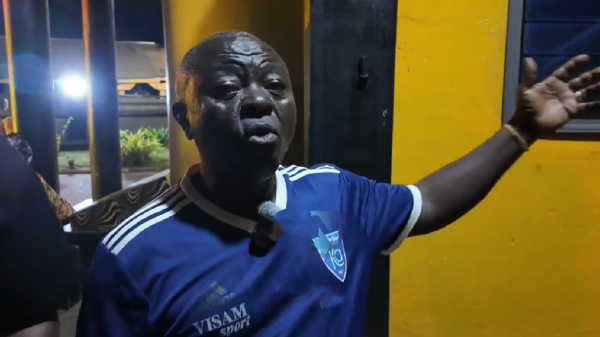


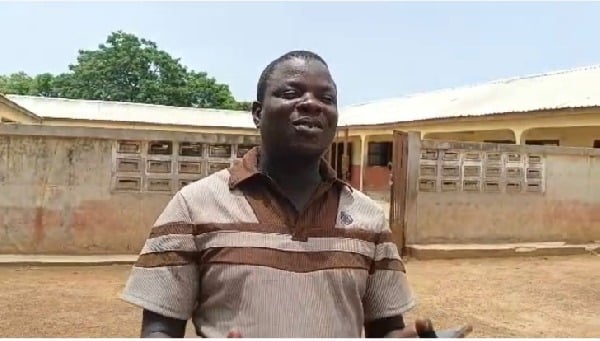
While many teachers prepare for one classroom each morning, Samuel Donkor begins his day knowing he must teach an entire school almost single-handedly.
At the Kakpeni District Assembly Primary and Junior High School in the Kpandai District of the Northern Region, Donkor has spent more than three years serving as the only government-trained teacher for 448 pupils, moving from class to class from Kindergarten to Junior High School without relief.
Every morning, he arrives before the first bell rings to organise lesson notes, check his chalk supply, and brace himself for another exhausting day. By the close of school, he would have taught core subjects including English Language, Mathematics, Science, and Ghanaian Language across 12 classes.
According to a report by Graphic Online published on May 8, 2026, Donkor has not only been teaching but also acting as the headteacher, effectively running the entire school on his own.
His situation has become so remarkable that residents and colleagues have nicknamed him “One Man Contractor”.
Multiple classes merged due to teacher shortage
To survive the severe staffing crisis, several classes have been merged into shared classrooms despite major differences in learning levels and syllabuses.
Kindergarten pupils study together with Basic One, Two, and Three learners in a single classroom, while Basic Four and Five have also been combined. Only Basic Six remains separated.

The arrangement has reportedly created enormous difficulties for both teachers and pupils, with many students struggling to keep up academically.
“I do what I can, but I know it is not enough. These children deserve more. By the time I reach the last class, the first class has forgotten what I taught them,” Donkor lamented.
Although two community volunteers occasionally assist him, their support is inconsistent because of low motivation and personal commitments.
‘There are more days without lessons’
The challenge becomes even worse whenever Donkor leaves the community for official assignments because teaching at the school virtually stops in his absence.
Travelling for such duties is itself dangerous. He reportedly has to cross a river by canoe, often without life jackets, particularly during the rainy season.
Despite the risks and pressure, he continues to show up daily.
“Most of my time is spent in the school and community, with little attention to my family and personal life,” he said.
Pupils and parents say the prolonged shortage is already affecting learning outcomes. Some students claim they regularly miss critical lessons in reading and numeracy.
“There are more days without lessons than days we are taught,” one pupil reportedly said.
Residents fear the growing educational gap could worsen social problems in the community, including teenage pregnancy and early marriage.
School lacks classrooms and teaching materials
Beyond staffing shortages, the school is also battling serious infrastructure deficits.
Some Junior High School students reportedly study under trees because of inadequate classroom space, leaving lessons exposed to harsh weather and frequent disruptions.
Furniture and teaching materials are also said to be insufficient.
Community members are therefore appealing to the Ministry of Education and the Ghana Education Service to urgently deploy more teachers to the school and include it in the School Feeding Programme to improve enrolment and retention.
There may, however, be some relief on the horizon.
The Kpandai District Education Directorate has confirmed that two additional teachers have been posted to the school and are expected to report soon.
For Donkor, who has carried the weight of an entire school for years, that support cannot come quickly enough.