


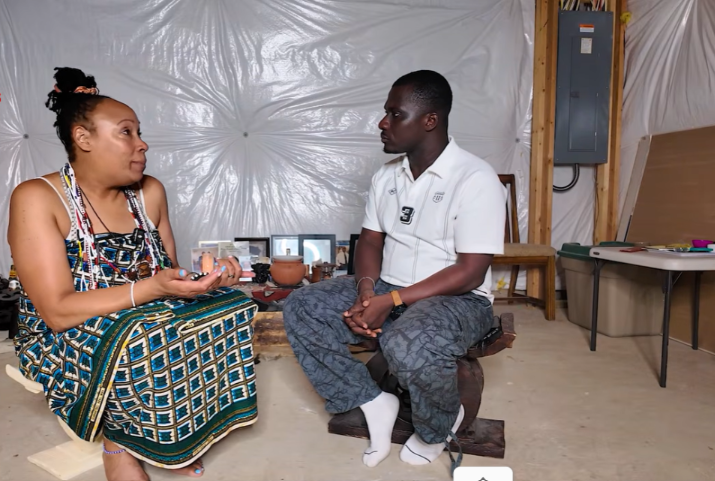
A Maryland lawyer turned Ghanaian fetish priestess says an African DNA test transformed her life, leading her to become a fully initiated Okomfuor after five years of training in Ghana. Lawranda Owens now balances a 30-year legal career representing children with disabilities with her spiritual role, challenging misconceptions about African traditional religion in the United States.
This story falls under Lifestyle
From courtroom to shrine
Lawranda Owens, whose shrine name is Nana Ofua Serwaa, also known as Okomfuor Serwaa, shared her extraordinary journey during an interview with Ghanaian blogger Zionfelix.
Follow our WhatsApp channel for more interesting and relevant news
Born in the United States, Owens said an African DNA test revealed her mother’s ancestry traces back to Nigeria’s Yoruba ethnic group, while her father’s roots are in Ghana. The discovery inspired her to reconnect with her heritage and set her on a journey that would eventually transform her into a Ghanaian fetish priestess.
Owens said reconnecting with her Ghanaian ancestry also helped her understand spiritual experiences she had lived with since childhood. According to her, she could see spirits, communicate with ancestors and travel in the spirit realm long before she knew the significance of those experiences.
“I am an Okomfuor. I can see, I hear, the spirits talk to me, I can see and talk to the ancestors. Before I even knew about this, I never fit in. I could see spirits. I could travel in spirit. I could wake up and tell my mum I had met my great grandparents whom I never met.”
Readers interested in Ghana’s traditional beliefs can also read Dove’s Unusual Taboos: The Volta Community Where Childbirth, Burials and Animal Rearing Are Forbidden.
Five years of training changed her life
Owens said becoming a fully initiated Okomfuor required five years of intensive training that combined instruction in the United States with regular trips to her ancestral village near Koforidua.
During the process, she learnt the local language, customs, taboos and spiritual practices before completing her initiation. She also shared a glimpse of her shrine in Maryland, where she keeps idols and other traditional spiritual objects used in her practice.
The transformation required major personal sacrifices.
Owens said she had to shave her hair, stop wearing makeup and dress in African clothing throughout her initiation, even while continuing her work as a lawyer.
“I had to cut my hair off, I could not wear makeup. I had to wear African clothes all the time, and as a lawyer, I had to wonder what people think of me.”
Challenging misconceptions about African spirituality
Owens disputed the belief held by some Ghanaians that traditional shrines cannot exist outside Africa.
She argued that many African spiritual traditions crossed the Atlantic during the transatlantic slave trade and continue to exist among African diaspora communities in the United States.
According to Owens, educating people has become a key part of her work because many Americans do not understand African traditional religion, while some Ghanaians doubt the authenticity of shrines established abroad.
She also said she continues to receive messages from ancestors through dreams, which she shares with people seeking spiritual guidance.
Nearly two decades after completing her initiation, Owens says she continues to balance her legal profession with her responsibilities as a Ghanaian fetish priestess, using both roles to serve people in different ways while promoting a better understanding of African traditional spirituality.
Related reads
- Dove’s Unusual Taboos: The Volta Community Where Childbirth, Burials and Animal Rearing Are Forbidden
- 10 Times Gun Displays at Funerals and Traditional Events in Ghana Ended in Death or Injuries
- How Clay Pots Along The Accra-Aflao Highway Built A 25-Year Pottery Business In Ghana
- 10 Unusual Taboos in Ghana and the Communities That Still Observe Them Today
- Inside Ghana’s thriving bead industry: How artisans in Amrahia turn recycled glass into cultural treasures
- Scientists discover rare new monkey species hidden in DR Congo rainforest after 14-year search
Explore more
News | Business | Entertainment | Lifestyle | Sports