



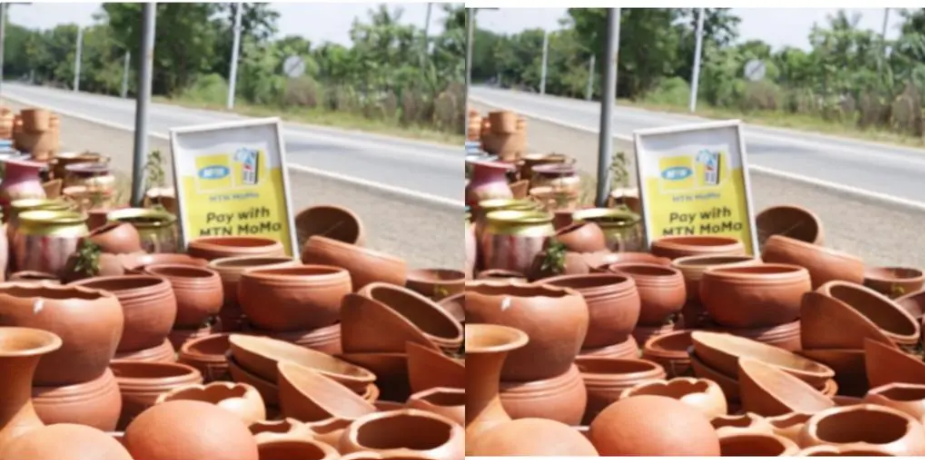
Some of the clay pots that line Ghana’s busy Accra-Aflao highway have been sitting in the same spot for as long as 15 years, quietly forming part of a long-running pottery business in Ghana that has thrived for 25 years.
At least, that is what it looks like to the thousands of motorists who speed past them every day.
To many travellers, the rows of earthen pots stretching from Vume through Tefle and towards Sokpoe in the lower Volta Basin appear frozen in time, like relics of a fading craft struggling to find buyers in a world dominated by plastic and metal products.
But appearances can be deceiving.
Those seemingly unmoving pots have helped one Volta Region couple build a home, raise a family, educate their children and create jobs for scores of people over the past quarter century.
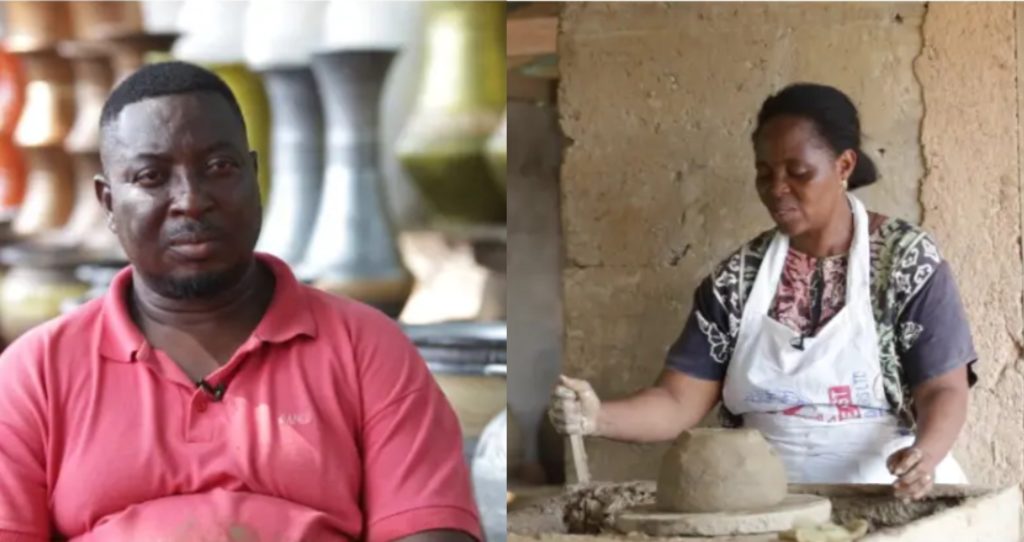
For 25 years, Stephen Kwashie Bonny and his wife, Agnes Bonny, have quietly built a successful pottery business in Ghana, proving that one of the country’s oldest industries still has the power to transform lives and create opportunities.
Their story is not only about clay.
It is about resilience, entrepreneurship and the untapped potential hidden within Ghana’s traditional industries.
The Roadside Showroom That Keeps Fooling People
The mystery of the roadside pots is one that Stephen Bonny has spent years explaining.
People often stop to ask why the same pots appear to have been sitting there for so long.
Some assume business must be slow.
Others conclude that nobody is buying them.
The reality is very different.
“The market is always being replenished,” Bonny explained with a smile.
What many travellers do not realise is that the roadside display functions as a giant open-air showroom.
When a pot is sold, another quickly takes its place.
Some customers place bespoke orders that are crafted specifically for them and never make it to the roadside market at all.
The result is an illusion that has persisted for years.
The display appears unchanged, even as thousands of pots quietly find new homes across Ghana and beyond.
“When we started this business about twenty-five years ago, sales were very good because we are located along an international road,” Bonny recalled.
“We used to export the pots to Togo, Nigeria and Burkina Faso, aside from distributing them to other parts of Ghana, mostly Accra.”
Today, demand still exists, although it fluctuates with the seasons.
The rainy season remains particularly important because that is when flower planting increases and demand for clay pots rises.
Far from winding down, Bonny has expanded his operations and constructed a new factory site.
It is not the kind of investment someone makes in a dying business.
Where Clay Becomes Livelihood
A few kilometres away from the roadside displays, the atmosphere is entirely different.
The smell of wet clay hangs in the air.
Workers move carefully around rows of freshly moulded pots left to dry beneath the sun.
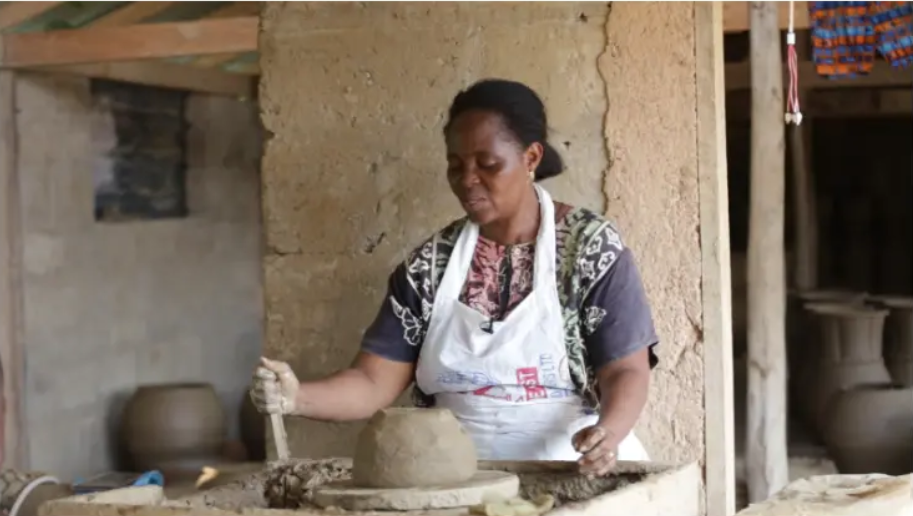
In one corner, artisans shape soft clay with practised hands, transforming lumps of earth into elegant flower pots and decorative pieces.
Elsewhere, painters focus intently on intricate designs, their fingers stained with layers of colour accumulated through years of experience.
The rhythmic tapping of tools against clay echoes through the workshop.
It is hard, physical work.
Yet for the people gathered here, the factory is far more than a workplace.
It is a source of income.
A source of dignity.
A source of hope.
This is the beating heart of a pottery business in Ghana that has survived economic downturns, changing consumer habits and growing competition from imported products.
A Family Built On Clay
For Stephen and Agnes Bonny, the pottery industry has provided far more than financial security.
It has shaped the trajectory of their entire family.
The couple have used proceeds from the business to build their own home, purchase a vehicle and educate their children.
Today, some of those children are teachers while others live abroad.
Yet all of them grew up learning the pottery trade.
For Agnes, that remains one of her proudest achievements.
The journey, however, was not always easy.
She remembers a time when people mocked them for choosing pottery as a profession.
Many viewed it as an outdated occupation with little future.
But while others doubted, she saw opportunities.
“This work is a good one, but people don’t understand,” she said.
“Initially, when we started, people mocked us. But I was the one selling the pots, and I knew the benefits, so I was determined to learn the pottery craft. My husband established a store for me, but I gave it up for this business.”
Her belief in the business became so strong that she eventually abandoned a retail store her husband had established for her and committed herself fully to pottery.
Years later, she remains convinced she made the right decision.
“It is lucrative because this is the work we have done for years through which we have educated all our children. Some are teachers, others are abroad, but they all know how to make pots.”
The Forgotten Industry Creating Jobs In The Volta Region
At a time when unemployment remains a major concern for many young Ghanaians, the Bonnys believe the pottery industry in Ghana deserves far more attention than it currently receives.
Peace and Unity Pottery and Ceramics currently provides direct employment for at least 15 people, excluding apprentices and interns who continue to learn the craft.
For workers such as Felix Morkar, pottery has been life-changing.
The painter has spent the last decade decorating clay pots at the factory.
His earnings have helped him support himself and contribute to the education of his younger siblings.
“Of course it is lucrative,” he said.
“When I completed Junior High School, I didn’t continue, and this is the work I have done for years to support my younger siblings in school and take care of my personal needs.”
“It is a very nice job, but it is difficult to learn, especially mastering how to mix colours.”
His experience illustrates a reality often overlooked in national conversations about employment.
Not every job comes from a multinational corporation or a government programme.
Sometimes opportunities emerge from local skills, local resources and local entrepreneurship.

Why Ghana May Be Overlooking A Valuable Resource
The Bonnys believe clay could do much more for Ghana’s economy if the right support were available.
Beyond flower pots and decorative products, clay can be used to manufacture roofing tiles, bricks, earthenware, water containers, drinking vessels and sanitary products.
With modern machinery and investment, they argue, local producers could diversify significantly and create even more jobs.
The raw materials already exist.
The skills already exist.
The market potential exists too.
What remains missing, they say, is meaningful support.
For years, politicians have spoken about industrialisation and job creation.
Yet many traditional industries continue to operate largely on their own.
For Bonny, the pottery sector represents a missed opportunity.
If properly developed, it could become an important contributor to local manufacturing while creating employment for hundreds of young people.

More Than Pots, They Are Pieces Of Ghanaian Heritage
The value of pottery extends beyond economics.
Clay products remain deeply connected to Ghanaian culture and craftsmanship.
That cultural significance is what caught the attention of American businessman Jean Paul Vandenbrauke while travelling towards Sogakope.
Captivated by the roadside displays, he stopped to admire the craftsmanship.
He believes clay pots should be appreciated not only as household items but also as artistic and cultural treasures.
“A plastic thing is functional, but we all need beauty,” he observed.
His comment captures something many people overlook.
In a world increasingly filled with mass-produced goods, handmade pottery carries a human touch that machines cannot replicate.
Each piece reflects patience, skill and tradition.
Each piece tells a story.

The Lesson Hidden In Plain Sight Along The Accra-Aflao Highway
Every day, thousands of motorists drive past the rows of clay pots that line sections of the Accra-Aflao highway.
Most never stop.
Many assume they are simply looking at old pots waiting for buyers.
Few realise they are looking at the visible face of a thriving pottery business in Ghana that has endured for 25 years.
For Stephen and Agnes Bonny, those pots represent far more than products.
They represent school fees paid.
Meals provided.
Dreams realised.
Jobs created.
And a future built from the very soil beneath their feet.
As the afternoon sun softens over Vume, Agnes often stands quietly beside the rows of clay pots, watching vehicles rush past without a second glance.
Sometimes she smiles.
Sometimes she simply shakes her head.
“We didn’t know clay would take us this far,” she said softly, her eyes moving across the long stretch of earth-toned pots.
“But it has given us everything.”
For Stephen, the commitment remains unchanged.
“As long as God gives me strength, I will continue making pots,” he said.
His words carry the quiet confidence of a man who has spent a quarter of a century proving sceptics wrong.
The clay pots lining the highway may appear motionless.
But behind them is a story of movement, growth and perseverance.
It is the story of a family that turned clay into opportunity — and a reminder that some of Ghana’s greatest economic potential may still be sitting in plain sight, waiting for the rest of the country to finally notice.