


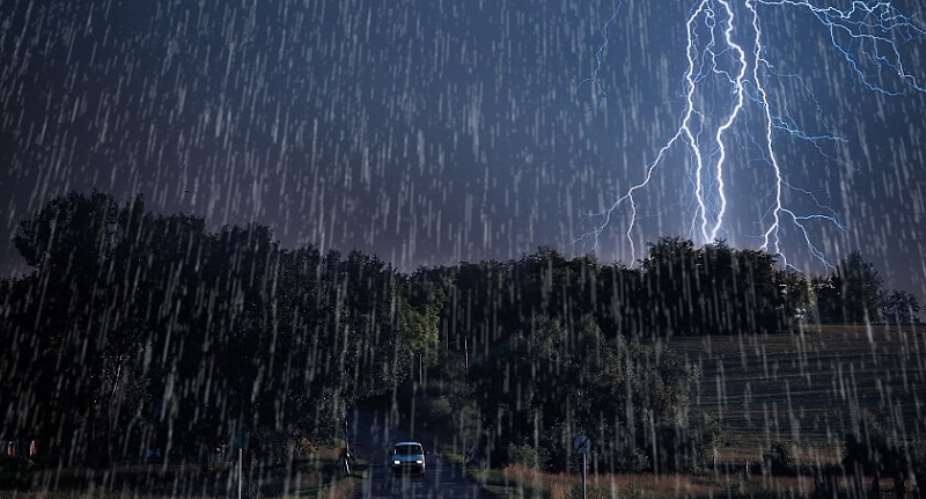
Residents across Ghana should brace for more rainfall and thunderstorms in the coming hours as the Ghana Meteorological Service forecasts wet weather conditions over several parts of the country on Wednesday, May 20.
The latest forecast says rainfall of varying intensities is expected across coastal and inland areas this morning, while thunderstorms and heavier rains are likely to spread across parts of the coast, inland zones, the transition belt, and sections of northern Ghana later in the day.
According to the weather agency, many parts of the country will begin the day under cloudy skies, with patches of mist or fog expected over mountainous and forest areas.
“Mostly cloudy conditions with patches of mist or fog are expected over mountainous and forest areas this morning. A few coastal and inland places may also experience rain,” the agency stated in its Wednesday morning forecast.
The agency added that although some areas may experience sunny intervals later in the day, unstable weather conditions are expected to persist.
“As the day progresses into the afternoon, breaks of sunshine are expected over most parts of the country. However, thunderstorms or rain of varying intensity are likely to affect parts of the coast and inland areas, extending into the transition zone and parts of the north during the afternoon and evening hours,” the statement added.
Accra and other parts continue to experience rainfall
Several parts of Ghana, including the capital Accra, have experienced consistent rainfall since the weekend, raising concerns about possible flooding in some communities if the rains intensify further.
The forecast suggests the wet conditions may continue over the coming days as the country gradually enters a more active phase of the rainy season.
Authorities have repeatedly advised residents in flood-prone areas to remain alert, especially during periods of heavy rainfall.
Northern Ghana faces difficult 2026 rainfall season
Beyond the immediate weather conditions, the Ghana Meteorological Agency has also projected a potentially challenging rainfall season for Northern Ghana in 2026.
According to the agency’s seasonal outlook, many parts of the north are expected to experience delayed rains, reduced rainfall amounts, and prolonged dry spells during the crucial farming season between May and September.
“The 2026 rainfall season in Northern Ghana is expected to begin at a normal to late time in most areas, although places such as Bole and Salaga may experience an early onset,” the agency stated.
The outlook covers a critical period for agriculture, food production, and water supply across the northern sector, where many farmers rely heavily on rainfall for crop cultivation.
Below-normal rainfall expected in many areas
The forecast indicates that much of Northern Ghana and sections of the middle belt could record below-normal to near-normal rainfall during the season.
“Rainfall during the May–September period is generally forecasted to be below-normal to near-normal across much of Northern Ghana and parts of the middle belt, while some southern coastal areas may record normal to above-normal rainfall,” the agency explained.
Meteorologists estimate that rainfall totals in the northern sector may range between 450mm and 700mm during the peak rainy season.
Experts warn that lower rainfall levels could significantly affect farming activities, especially in communities that depend on rain-fed agriculture for livelihoods and food production.
Prolonged dry spells raise concern
One of the major concerns highlighted in the outlook is the likelihood of extended dry spells in several northern regions.
“The northern sector is expected to receive between 450mm and 700mm of rainfall during the peak season, with dry spells ranging from about 10 to 18 days in some areas, particularly across the Upper East, Upper West, and Transition zones,” the forecast noted.
Agricultural experts say prolonged periods without rain could affect crop growth, reduce yields, and place additional pressure on already strained water resources.
Farmers have therefore been encouraged to monitor weather updates closely and adopt climate-smart farming methods to minimise possible losses.
Authorities urge early preparedness
The agency also warned that while some areas may experience reduced rainfall, others could still face isolated flooding and heavy rainfall events.
“Stakeholders and the public are advised to prepare for possible impacts such as flooding, heavy rainfall events, and prolonged dry spells through early preparedness and risk management,” the agency advised.
Communities have been urged to clear choked drains, protect farmlands, and strengthen local emergency response plans ahead of the peak rainy period to reduce the risk of destruction caused by extreme weather conditions.